The year 2026 finds the landscape of global education at a fascinating crossroads. While the “Top 10” lists are still populated by the usual suspects, the rivalry between the University of Oxford and the Massachusetts Institute of Technology (MIT) has evolved into something much deeper than a simple tally of Nobel Prizes or endowment sizes.
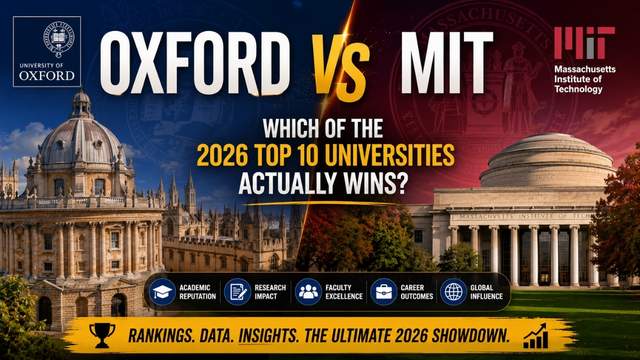
If you’re standing on the outside looking in, trying to decide which of these titans “wins,” you first have to ask yourself: what are we actually measuring? Is it the power to decode the universe through a silicon chip, or the ability to lead a nation through the nuances of history and philosophy?
In 2026, the answer isn’t found in a spreadsheet. It’s found in the friction between tradition and the future.
The Metric of Prestige: Rankings vs. Reality
For the better part of a decade, MIT has held a iron grip on the #1 spot in global rankings, particularly the QS World University Rankings. Its dominance in STEM (Science, Technology, Engineering, and Mathematics) is undisputed. However, 2026 has seen Oxford close the gap by leaning into its unique strengths: personalized education and interdisciplinary “Human-Centric AI.”
While MIT wins on citations per faculty—a fancy way of saying their research is the most talked about in the scientific community—Oxford consistently wins on employer reputation. There is a certain “Oxford Brand” that suggests a level of critical thinking and oratorical polish that even the most brilliant coder at MIT might struggle to replicate.
| Feature | Massachusetts Institute of Technology (MIT) | University of Oxford |
| Core Philosophy | Mens et Manus (Mind and Hand) | Dominus Illuminatio Mea (The Lord is my Light) |
| Learning Style | Collaborative, Project-based, High-pressure | Tutorial-based, Independent, Dialectical |
| Global Ranking (2026) | Traditionally #1 | Traditionally Top 3 |
| Best For | Innovation, Startups, Deep Tech | Leadership, Law, Humanities, Fundamental Science |
The MIT Edge: Engineering the Future
Walking through the Infinite Corridor at MIT in 2026 feels like stepping into a prototype of the next century. The energy is kinetic. MIT doesn’t just teach you how to understand the world; it expects you to build a better one by next Tuesday.
The “win” for MIT lies in its innovation ecosystem. In 2026, the integration between MIT’s labs and the surrounding biotech hub of Kendall Square is seamless. If you are a student with a radical idea for a fusion reactor or a carbon-capture material, the distance between your classroom and a venture capital check is shorter here than anywhere else on Earth.
Why MIT wins:
- The Maker Culture: Students have 24/7 access to some of the most advanced fabrication tools in existence.
- Interdisciplinary Speed: MIT breaks down silos faster than most. A linguist and a roboticist might share a coffee and accidentally revolutionize natural language processing.
- The “Hacker” Ethos: There is a unique resilience bred at MIT. The workload is famously referred to as “drinking from a firehose,” which produces graduates who are virtually unshakeable in high-pressure tech environments.
The Oxford Edge: The Art of the Argument
On the other side of the Atlantic, Oxford offers something that 2026’s increasingly automated world desperately needs: the tutorial system.
While the rest of the world moves toward massive open online courses (MOOCs) and AI-driven grading, Oxford remains stubbornly, gloriously human. Once or twice a week, you sit in a room with one of the world’s leading experts and one other student to defend an essay you’ve spent 40 hours researching. There is nowhere to hide. You cannot “algorithm” your way out of a tutorial.
Why Oxford wins:
- Critical Thinking: Oxford doesn’t just teach you what to think, but how to dismantle an argument. In an era of deepfakes and misinformation, this is a superpower.
- The College System: Being a member of a college (like Magdalen or Balliol) provides a built-in community that balances the intensity of the university. It’s a “home” that spans centuries.
- Longevity: There is a psychological weight to studying in a place that has survived plagues, civil wars, and world wars. It gives students a sense of stewardship over the future rather than just a drive for the next “disruptive” app.
The “Cost of Living” vs. The “Cost of Learning”
By 2026, the financial conversation has shifted. MIT remains eye-wateringly expensive for those without significant financial aid, though its “need-blind” admission policy for domestic and international students remains a gold standard.
Oxford, while having seen fee increases for international students post-Brexit, often feels like the more “attainable” elite option for those coming from outside the US. However, the cost of living in Oxford—a small city with a housing crisis—rivals that of Cambridge, Massachusetts.
The “win” here depends on your financial philosophy. MIT is a high-risk, high-reward investment in “The New.” Oxford is a stable, prestigious investment in “The Permanent.”
The Verdict: Who Actually Wins in 2026?
If we are looking at pure technological output, MIT wins. The world’s transition to sustainable energy and quantum computing is being scripted in Cambridge, MA. If you want to be the person who writes the code that runs the world, MIT is your champion.
However, if we are looking at the governance of that technology, Oxford wins. As AI begins to touch every aspect of human life, the ethical, legal, and philosophical frameworks required to keep society intact are being forged in the halls of Oxford.
“MIT builds the tools; Oxford asks if we should use them.”
In 2026, the “Top 10” list is a tie at the top, but for different reasons.
- MIT wins the battle for Progress. Its graduates are the architects of the 21st-century infrastructure.
- Oxford wins the battle for Perspective. Its graduates are the ones tasked with making sense of that progress and ensuring it serves humanity.
Ultimately, the university that “wins” is the one that aligns with your personal definition of success. Do you want to be the person who invents the future, or the person who leads us through it? Luckily for the world of 2026, we still have both.