The landscape of global higher education is no longer a localized competition. In the 21st century, the pursuit of knowledge has become a borderless endeavor, where the world’s most prestigious institutions compete for the brightest minds, groundbreaking research funding, and the cultural capital that comes with being a “global academic leader.”
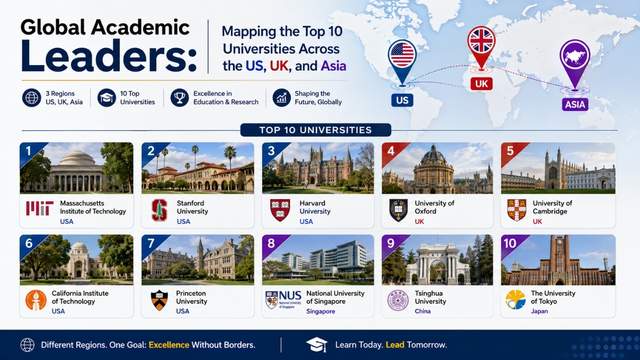
When we map the top 10 universities across the United States, the United Kingdom, and Asia, we aren’t just looking at a list of names; we are looking at the engines of human progress. These institutions serve as the breeding grounds for Nobel laureates, tech innovators, and heads of state. However, the flavor of excellence varies significantly depending on which part of the map you are looking at.
The American Titans: Innovation and Endowment
In the United States, the concept of a “top university” is often synonymous with the Ivy League and a few West Coast powerhouses. The US dominates global rankings through a combination of massive private endowments, a culture of “disruptive” innovation, and an unparalleled ability to attract international talent.
1. Massachusetts Institute of Technology (MIT): Consistently ranked as the number one university in the world, MIT is less a school and more a laboratory for the future. Its proximity to the tech hubs of Cambridge and Boston allows for a seamless flow between academic theory and commercial application. 2. Stanford University: If MIT is the engine of the East Coast, Stanford is the heart of Silicon Valley. Its campus is the birthplace of companies like Google and Hewlett-Packard. Stanford’s multidisciplinary approach encourages students to bridge the gap between humanities and high tech. 3. Harvard University: As the oldest institution in the US, Harvard carries a weight of prestige that is almost tangible. Its influence spans every sector of global society, from the Supreme Court to the upper echelons of international finance. 4. California Institute of Technology (Caltech): While smaller in scale, Caltech’s impact on the hard sciences is astronomical. It manages NASA’s Jet Propulsion Laboratory and maintains a student-to-faculty ratio that ensures every student is part of high-level research from day one.
The British Bastions: Tradition and Rigor
Across the Atlantic, the United Kingdom offers a different model of excellence. While the US focuses on the “all-around” student and broad liberal arts foundations, the UK system—led by the “Golden Triangle” of London, Oxford, and Cambridge—prizes deep specialization and centuries-old pedagogical traditions.
5. University of Oxford: Oxford is the oldest university in the English-speaking world. Its unique “tutorial” system, where students meet one-on-one or in tiny groups with world-leading experts, creates a level of intellectual intimacy that is hard to find elsewhere. 6. University of Cambridge: Often seen as the more “scientific” sibling to Oxford, Cambridge has been the home of Newton, Darwin, and Hawking. Its contribution to the world of mathematics and physics is peerless, and its “collegial” structure offers students a sense of belonging within a massive global institution. 7. Imperial College London: Unlike the ancient universities, Imperial is a modern powerhouse focusing almost exclusively on science, engineering, medicine, and business. Located in the heart of South Kensington, it acts as a bridge between British research and global industry.
The Asian Ascent: The New Frontiers
Perhaps the most exciting shift in the last two decades is the rise of Asian universities. Fueled by heavy government investment and a cultural reverence for education, institutions in China and Singapore are no longer just “catching up”—they are setting the pace in fields like Artificial Intelligence and Material Sciences.
8. National University of Singapore (NUS): NUS has become the gold standard for education in Asia. It sits at the crossroads of East and West, offering a curriculum that blends the rigorous technical standards of Asia with the creative flexibility of Western institutions. 9. Tsinghua University (China): Located in Beijing, Tsinghua is often called the “MIT of China.” It is the premier training ground for China’s political and technological elite. Its research output in STEM fields is now rivaling—and in some cases exceeding—the top US institutions. 10. Peking University (China): While Tsinghua dominates the sciences, Peking University (PKU) is the soul of China’s intellectual and social history. It is renowned for its humanities and social sciences, standing as a symbol of China’s modernization and its deep-rooted cultural heritage.
The Shifting Dynamics: What Sets Them Apart?
Mapping these ten giants reveals a fascinating evolution in how we define “success.”
In the United States, the focus remains on the “entrepreneurial university.” The goal is not just to learn, but to build. This is why the US remains the leader in patents and startups. However, this comes with a high price tag, as tuition costs continue to spark global debate about the accessibility of elite education.
In the United Kingdom, the emphasis is on “depth of thought.” The UK produces graduates who are experts in their specific niche by the time they finish their undergraduate degrees. The environment is one of quiet intensity, where the ghosts of past thinkers seem to push the current generation toward excellence.
In Asia, the narrative is one of “rapid transformation.” These universities are the pillars of national development. They are remarkably efficient, moving from being regional players to global leaders in a fraction of the time it took their Western counterparts. The work ethic is legendary, and the focus is increasingly on future-proofing their economies through AI and green energy.
The Challenges Ahead
Despite their prestige, these top 10 universities face a common set of challenges. The first is the “Ivory Tower” critique—the idea that these institutions are becoming too elite and disconnected from the problems of the average citizen. To combat this, many are expanding their online offerings and global campuses.
The second challenge is geopolitical. As tensions rise between the West and East, the once-fluid exchange of researchers and students is facing new hurdles. The future of these academic leaders will depend on their ability to remain “global” in an increasingly fragmented world.
Conclusion: A Global Tapestry of Knowledge
Mapping the top 10 universities across the US, UK, and Asia shows us that there is no single “right” way to achieve academic greatness. Whether it’s through the high-tech labs of MIT, the ancient libraries of Oxford, or the hyper-modern research centers of Tsinghua, these institutions represent the peak of human intellectual ambition.
For a student today, the choice is no longer just about which subject to study, but which cultural philosophy they want to inhabit. Do they want the American dream of innovation, the British tradition of specialization, or the Asian spirit of rapid advancement? Regardless of the path, these ten universities remain the compass by which the rest of the world’s academic institutions steer their course.