The landscape of higher education in 2026 has officially moved past the “digital transition” and into a new era of radical adaptability. As the global economy grapples with the rapid integration of artificial intelligence, green energy shifts, and a demand for specialized human skills, the world’s leading universities have fundamentally redesigned their DNA.
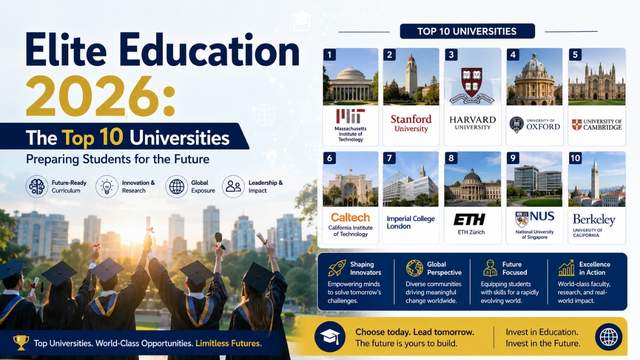
The “Elite Education 2026” rankings don’t just reward historical prestige; they spotlight institutions that bridge the gap between classroom theory and future-proof career readiness. Here are the top 10 universities preparing students to lead in an unpredictable world.
1. Massachusetts Institute of Technology (MIT) – USA
Core Strength: Hyper-Innovation & AI Integration
For the 14th consecutive year, MIT holds the global crown. In 2026, MIT has become the “Epicenter of Intelligence,” having fully integrated generative AI across every department, from architecture to astrophysics. Students here aren’t just learning code; they are mastering the ethics and orchestration of autonomous systems. With its “LINC” (Learning in Networked Communities) initiative, MIT ensures that every graduate is fluent in cross-disciplinary problem solving, making them the most sought-after candidates in the tech-heavy 2026 job market.
2. University of Oxford – UK
Core Strength: Resilience & Global Governance
Oxford has reclaimed its throne in several rankings this year by doubling down on what it does best: deep, critical thinking. In a world of fast-paced “snackable” content, Oxford’s tutorial system remains the gold standard for developing the human intellect. Their 2026 curriculum focus centers heavily on “Global Resilience,” preparing students to navigate climate policy, international law, and the social implications of a post-labor economy.
3. Stanford University – USA
Core Strength: The Entrepreneurial Ecosystem
Located in the heart of a maturing Silicon Valley, Stanford remains the premier launchpad for the next generation of founders. By 2026, Stanford’s “Stanford 2025” vision has come to life, allowing students more flexible, “open-loop” education where they can move between the university and industry projects seamlessly. This “education-as-a-service” model allows students to build real-world products while earning their degrees, making the leap to the professional world nearly invisible.
4. University of Cambridge – UK
Core Strength: Scientific Discovery & Life Sciences
Tied for a podium spot, Cambridge continues to dominate the biotech and life sciences sectors. With the 2026 opening of new collaborative labs in the “Silicon Fen,” students are at the forefront of CRISPR breakthroughs and personalized medicine. Cambridge’s focus is on “Long-form Excellence,” ensuring that even as the world speeds up, the rigor of scientific inquiry remains uncompromised.
5. Princeton University – USA
Core Strength: Undergraduate Research Excellence
Princeton has seen a meteoric rise in 2026 due to its unmatched focus on the undergraduate experience. While other schools prioritize massive research output, Princeton ensures that every student—regardless of major—completes a senior thesis that contributes original knowledge to their field. This emphasis on “Applied Curiosity” creates graduates who are not just followers of best practices, but creators of new ones.
6. Imperial College London – UK
Core Strength: STEMB (Science, Tech, Engineering, Medicine, & Business)
Imperial has risen significantly in 2026 by perfecting the “STEMB” model. They have recognized that a scientist who doesn’t understand business, or a doctor who doesn’t understand data, is at a disadvantage. Their new “I-X” (Imperial-X) campus uses AI to facilitate a collaborative space where students from different disciplines work on “Grand Challenges,” such as carbon capture and pandemic prevention.
7. ETH Zurich – Switzerland
Core Strength: Sustainable Engineering & European Innovation
As the highest-ranking university in continental Europe, ETH Zurich is the undisputed leader in green technology. In 2026, as the world pushes toward “Net Zero,” ETH graduates are the primary architects of the new energy infrastructure. Their focus on “Circular Engineering”—designing products and systems that never become waste—aligns perfectly with the industrial demands of the late 2020s.
8. National University of Singapore (NUS) – Singapore
Core Strength: The Asian Gateway & Lifelong Learning
NUS represents the unstoppable rise of Asian education. By 2026, NUS has successfully pioneered the “Continuing Education” model, where a degree is seen as a 20-year relationship rather than a four-year transaction. Their focus on “Smart Nation” technologies and urban sustainability makes their graduates the preferred choice for the rapidly growing megacities of the East.
9. University of California, Berkeley – USA
Core Strength: Social Impact & Public Interest Tech
UC Berkeley remains the premier public university, excelling in what is now called “Public Interest Technology.” Berkeley students are leading the charge in ensuring that the tech revolution doesn’t leave the vulnerable behind. Their 2026 focus on “Algorithmic Justice” and “Climate Equity” prepares students for roles in NGOs, government, and socially-conscious corporations that are defining the modern ESG (Environmental, Social, and Governance) landscape.
10. Peking University – China
Core Strength: Quantum Computing & AI Sovereignty
Rounding out the top 10 is Peking University, reflecting China’s massive investment in “Future Frontiers.” Peking U has become a world leader in quantum information sciences and advanced materials. In 2026, the university’s curriculum is deeply integrated with the country’s national innovation goals, producing graduates who are at the absolute cutting edge of the physical and digital sciences.
The 2026 Shift: Skills Over Syllabus
What makes these ten institutions different from their 20th-century ancestors? It isn’t just their history or their endowments. It is a fundamental shift in pedagogy.
The elite universities of 2026 have moved away from standardized testing and toward Portfolio-Based Assessment. Students no longer just show a transcript; they show a digital portfolio of solved problems, coded applications, and published research.
Furthermore, the rise of Stackable Micro-credentials has allowed these top schools to remain relevant. Even a student at Harvard or Oxford might take a specific “AI Ethics” module from MIT or a “Green Finance” certification from ETH Zurich to round out their profile.
Why These Rankings Matter for You
If you are a student or a professional looking to upskill in 2026, the message is clear: The future belongs to the “T-Shaped” individual. You need a deep vertical expertise in one area (like Data Science or Law) but a broad horizontal understanding of how that field interacts with others (like Ethics, Psychology, or Environmental Science).
The institutions on this list have realized that the “Future of Work” is a moving target. By teaching students how to learn rather than what to know, these top 10 universities are ensuring that their graduates remain the masters of the 2026 economy—and beyond.