The allure of the “Top 10” is a powerful force in global education. Names like Harvard, Stanford, Oxford, and MIT carry a weight that transcends borders, promising not just a degree, but a golden ticket to elite networks, cutting-edge research, and lifelong prestige. But as acceptance rates at these institutions plummet into the low single digits, a frantic mythology has grown around the admissions process.
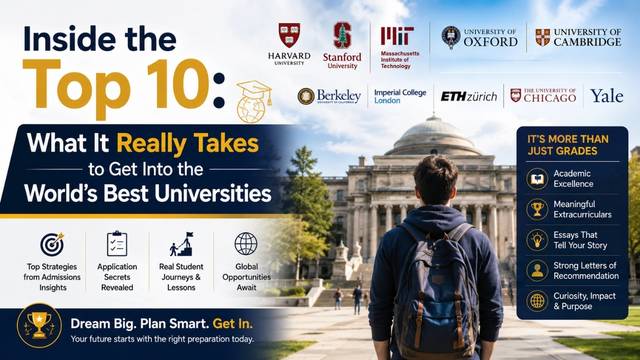
Parents and students often ask: What is the secret formula? Is it a perfect SAT score? A bookshelf of trophies? A Nobel-prize-winning internship? The reality is both simpler and far more complex. Getting into the world’s best universities isn’t about checking boxes; it’s about demonstrating a rare alignment of intellectual vitality, cultural fit, and what admissions officers call “institutional need.”
The Myth of the “All-Rounder”
For decades, the conventional wisdom was to be a “well-rounded” student. You were told to play an instrument, captain a sports team, volunteer at a soup kitchen, and maintain a high GPA. Today, for the global Top 10, being well-rounded is often a recipe for being overlooked.
Top-tier universities are no longer looking for a class of well-rounded individuals; they are looking for a well-rounded class of “pointy” individuals. They want the world-class oboist, the math prodigy, the social justice activist, and the student who built a fusion reactor in their garage. They are looking for “spikes”—areas of extreme excellence that indicate a student has the potential to move the needle in their chosen field.
Intellectual Vitality: Beyond the Grade Point Average
Academic excellence is the baseline. At Harvard or Cambridge, almost every applicant has a near-perfect GPA and top-tier standardized test scores. If you don’t meet the academic threshold, your application likely won’t survive the first “cull.” However, once you pass that threshold, grades cease to be the deciding factor.
What these schools look for next is “intellectual vitality.” This is the spark of genuine curiosity. Do you read beyond the syllabus? Have you engaged in independent research? A student who takes an online course in Linear Algebra because their school didn’t offer it, or who spends their weekends translating ancient Greek texts for fun, demonstrates a love for learning that cannot be manufactured by a private tutor.
The Power of the Narrative
In the hyper-competitive world of elite admissions, your application is a story. The most successful candidates are those who can weave their experiences, essays, and recommendations into a cohesive narrative.
The personal statement is the heart of this narrative. It is not a CV in prose form. Rather, it is a window into how a student thinks. The best essays are often small and vulnerable. They don’t focus on the “what” (I won the state championship) but the “why” and “how” (How did losing that championship change my definition of leadership?). Top universities are looking for self-awareness and emotional intelligence—traits that suggest a student will contribute positively to the campus community.
Extracurriculars: Depth Over Breadth
Admissions officers can spot “resume padding” from a mile away. Joining ten clubs in your senior year does not impress them. What impresses them is sustained commitment and tangible impact.
Whether it’s a sport, a hobby, or a part-time job, top universities want to see that you have “gone deep.” They look for leadership that isn’t just a title, but an action. Did you scale a local charity to a national level? Did you mentor younger students? Even non-traditional extracurriculars, like taking care of a sick relative or working 20 hours a week at a grocery store to help with family finances, carry immense weight because they demonstrate character, resilience, and time management.
The “Black Box” of Institutional Need
This is the part of the process that students have the least control over, yet it is often the most significant. Every year, a university has specific goals. Perhaps the engineering department is expanding and needs more female students. Perhaps the orchestra needs a bassoonist. Perhaps the university is looking to increase its geographic diversity by admitting more students from Southeast Asia or rural America.
You could be an objectively “perfect” candidate, but if the university already has fifty students with your exact profile, they may pass you over for someone who fills a specific gap in their incoming class. This is why a rejection from a Top 10 school is rarely a reflection of a student’s worth; it is often a matter of the “puzzle” the admissions office is trying to solve that year.
The Global Difference: US vs. UK
While the Ivy League and Oxbridge (Oxford and Cambridge) are often lumped together, their criteria differ significantly.
The UK system is almost entirely academic. At Oxford or Cambridge, they care very little about your extracurricular activities unless they relate directly to your subject of study. Their interviews are legendary for being “academic auditions”—tutors will give you a problem you’ve never seen before and watch how you think through it in real-time.
The US system, by contrast, is “holistic.” They care about your character, your background, your potential for leadership, and how you will fit into the “vibe” of the campus. Stanford looks for “fearless” innovators; Princeton looks for students dedicated to service.
The Mental Cost of the Chase
It is impossible to discuss the Top 10 without acknowledging the immense pressure placed on teenagers. The “arms race” of elite admissions has led to a mental health crisis among high-achieving students. The obsession with “prestige” can lead students to pursue activities they don’t enjoy and subjects they aren’t passionate about, simply to please an admissions committee.
The irony is that the qualities these universities value most—originality, passion, and risk-taking—are often stifled by a rigid adherence to a “perfect” path. The most successful applicants are often those who weren’t afraid to fail, who took the “wrong” class because it sounded interesting, and who followed their own curiosity rather than a consultant’s roadmap.
Conclusion: Is it Worth It?
Getting into a Top 10 university is an extraordinary achievement, but it is not the only path to success. Data shows that for high-achieving students, their long-term career outcomes are more dependent on their own traits—their drive, work ethic, and networking skills—than the name on their diploma.
However, for those who do make it inside the gates of the world’s best universities, the reward is an environment where they are surrounded by the brightest minds of their generation. To get there, you don’t need to be a superhero. You need to be a person of depth, a student of intense curiosity, and an individual who has something unique to contribute to the global conversation.
The secret isn’t in being the best at everything; it’s in being the best version of yourself, expressed through a clear, authentic, and ambitious lens. The Top 10 are looking for the leaders of tomorrow, but they start by looking for the thinkers of today.