The landscape of higher education has never been more competitive, or more fascinating. As we step into mid-2026, the latest global rankings—the “Gold Standard” reports from QS and Times Higher Education (THE)—reveal a world in transition. While the heavyweights of the Ivy League and the Oxbridge elite still hold the throne, a “quiet revolution” is occurring as Asian institutions and specialized tech hubs climb the ladder.
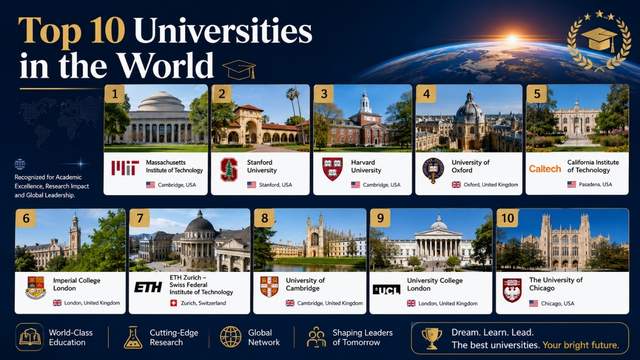
Whether you are a student planning your future, a researcher seeking the next big lab, or simply a curious observer, here is the definitive breakdown of the Top 10 Universities in the World for 2026.
1. Massachusetts Institute of Technology (MIT) – USA
For an incredible 14th consecutive year, MIT sits atop the QS World University Rankings. MIT isn’t just a school; it’s a global engine for innovation.
- The X-Factor: Its “Mind and Hand” philosophy. In 2026, MIT continues to lead the charge in Generative AI ethics and Climate Technology.
- Why it’s #1: Perfect scores in academic reputation and employer reputation. If you want to build the future, this is the workshop.
2. University of Oxford – UK
While MIT wins on the QS scale, the Times Higher Education (THE) 2026 rankings place Oxford at #1 for a record-breaking 10th year.
- The X-Factor: Unmatched research output. Oxford’s multidisciplinary approach—blending ancient humanities with cutting-edge medical science—remains the gold standard.
- Strengths: Anatomy, Physiology, and English Literature.
3. Imperial College London – UK
Imperial has made a massive leap this year, overtaking long-time rivals to claim a podium spot. It is now widely considered the “MIT of Europe.”
- The X-Factor: A hyper-focus on STEM and Medicine.
- Recent Wins: Its integration of AI into clinical healthcare research has made it the top choice for the next generation of biotech entrepreneurs.
4. Stanford University – USA
Located in the heart of Silicon Valley, Stanford remains the ultimate bridge between academia and industry.
- The X-Factor: Entrepreneurship. Stanford’s alumni have founded companies that produce trillions in annual revenue.
- Focus Areas: Computer Science, Economics, and Sustainability.
5. Harvard University – USA
Harvard remains the most “famous” university in the world, holding the top spot for Life Sciences and Medicine in 2026.
- The X-Factor: Prestige and Resources. With the world’s largest academic endowment, Harvard provides a safety net and a springboard for world-shaping research.
- Trends: While it slipped slightly in “international outlook” due to domestic policy shifts, its academic influence remains peerless.
The Comparison: How the Top 10 Stack Up
Different ranking bodies use different metrics. While QS values “Employer Reputation,” THE leans heavily into “Research Quality.”
| Rank (Avg) | University | Country | Key Strength |
| 1 | MIT | USA | Technology & Innovation |
| 2 | Oxford | UK | Research & Humanities |
| 3 | Imperial College | UK | Engineering & Medicine |
| 4 | Stanford | USA | Entrepreneurship |
| 5 | Harvard | USA | Law & Life Sciences |
| 6 | Cambridge | UK | Mathematics & History |
| 7 | ETH Zurich | Switzerland | Earth & Marine Sciences |
| 8 | NUS | Singapore | Analytics & Global Trade |
| 9 | UCL | UK | Architecture & Education |
| 10 | Caltech | USA | Space Science & Physics |
6. University of Cambridge – UK
Cambridge continues to be a powerhouse of discovery. In 2026, it remains the top destination for Mathematics and Archaeology.
- The Vibe: Deeply traditional yet scientifically radical. Its “Collegiate System” provides a small-community feel within a world-class research giant.
7. ETH Zurich – Switzerland
As the highest-ranked university in Continental Europe, ETH Zurich is the standard-bearer for technical excellence.
- The X-Factor: Affordability vs. Quality. Unlike its US/UK peers, ETH offers world-class education at a fraction of the tuition cost, attracting the best minds from across the globe.
- Image Suggestion:
8. National University of Singapore (NUS) – Singapore
NUS is the star of the “Asian Century.” It has firmly established itself in the Top 10, proving that the center of gravity in higher education is shifting East.
- The X-Factor: Digital Intelligence. NUS leads in Data Analytics and Urban Planning, serving as a “living lab” for the smart cities of tomorrow.
9. University College London (UCL) – UK
Known as “London’s Global University,” UCL excels in the Social Sciences and Education.
- Why it’s here: Its commitment to diversity and its massive jump in Research Impact scores have kept it ahead of many Ivy League schools this year.
10. California Institute of Technology (Caltech) – USA
Caltech is small but mighty. With a tiny student body and a high concentration of Nobel laureates, it focuses on “big science.”
- The X-Factor: Space Exploration. Through its management of NASA’s Jet Propulsion Laboratory (JPL), Caltech is essentially the academic headquarters for Mars exploration.
2026 Trends: What’s Changing?
The Rise of the “Global South”
While the Top 10 is still dominated by the US and UK, the “Top 100” is changing rapidly. China now has five universities in the Top 40 (led by Tsinghua and Peking), and India has seen its highest representation ever, with IIT Delhi and IIT Bombay climbing significantly in the 2026 cycle.
The “Employability” Pivot
In 2026, students are looking for ROI (Return on Investment). Rankings have adjusted to this, placing higher weight on Employment Outcomes. This is why schools like Imperial and NUS, which have direct pipelines to high-growth industries, are seeing such strong gains.
Sustainability as a Metric
For the first time, “Social and Environmental Impact” is a major factor in these rankings. Universities are now being judged not just by how many papers they publish, but by their carbon footprint and their research contributions to the UN Sustainable Development Goals.
Final Thoughts: Does Rank Really Matter?
Rankings are a great compass, but they shouldn’t be your only map. A university that is #1 for Physics might be #50 for Fine Arts.
As we look at the 2026 edition, the “Ultimate Ranking” tells us one thing: the world of knowledge is becoming more interconnected. The “best” university is no longer just the one with the oldest buildings, but the one that prepares its students to solve the complex, global challenges of the mid-21st century.